ENGLAND'S FORGOTTEN FOOTBALLER...
THE TALE OF SCHOOLBOY INTERNATIONAL BENNY ODEJE, LOST TO HISTORY, UNTIL RECENT, BELATED, RECOGNITION...
Ask who the first Black footballer to represent England was and most people will probably mention Viv Anderson, who was indeed the first to play for the England Men’s Senior side in 1978. Some might suggest Laurie Cunningham, who got the call-up for England's U21s a year earlier. Few will mention a south London schoolboy from Deptford. Even fewer might add that, during two short spells in the mid-70s, 'Benny' Odeje also played for Dulwich Hamlet.
Born in Nigeria in 1955, Ben moved to Britain with his parents in the 1960s. By 1966, the youngster attended Lucas Vale Primary School in Deptford, south east London and credits teacher Mr Wynn with being the first to encourage his talent and instil self-belief in him. "Mr Wynn was teacher, coach, advisor... my everything at school," recalled Odeje years later. "He saw something in me that other people did not. He also made me use my left foot, so that I became a two-footed player.” The sentiment by the school team captain Chris Hill, “Benny had never kicked a ball until he joined Mr Wynn’s class in 1966. He spoke very little English, but he was a very quick learner. Our sole tactic became ‘give the ball to Benjie’ and then we often stood back and watched him score.”
By 1968, Ben was attending South East London Secondary School in Deptford. He scored eight times on his First Year XI debut – his goals crucial to that side winning the double. In three season's he became something of a footballing prodigy – a rapid striker with "amazing speed", he scored nearly 400 goals, acquiring the nickname 'Pelé' along the way whilst playing for school teams, Blackheath District and London Schoolboys - then coached by future England and Crystal Palace manager Roy Hodgson. Chelsea showed interest, but his parents were not keen on him travelling so far to train, so whilst still living in New Cross, he signed schoolboy forms with Charlton Athletic.
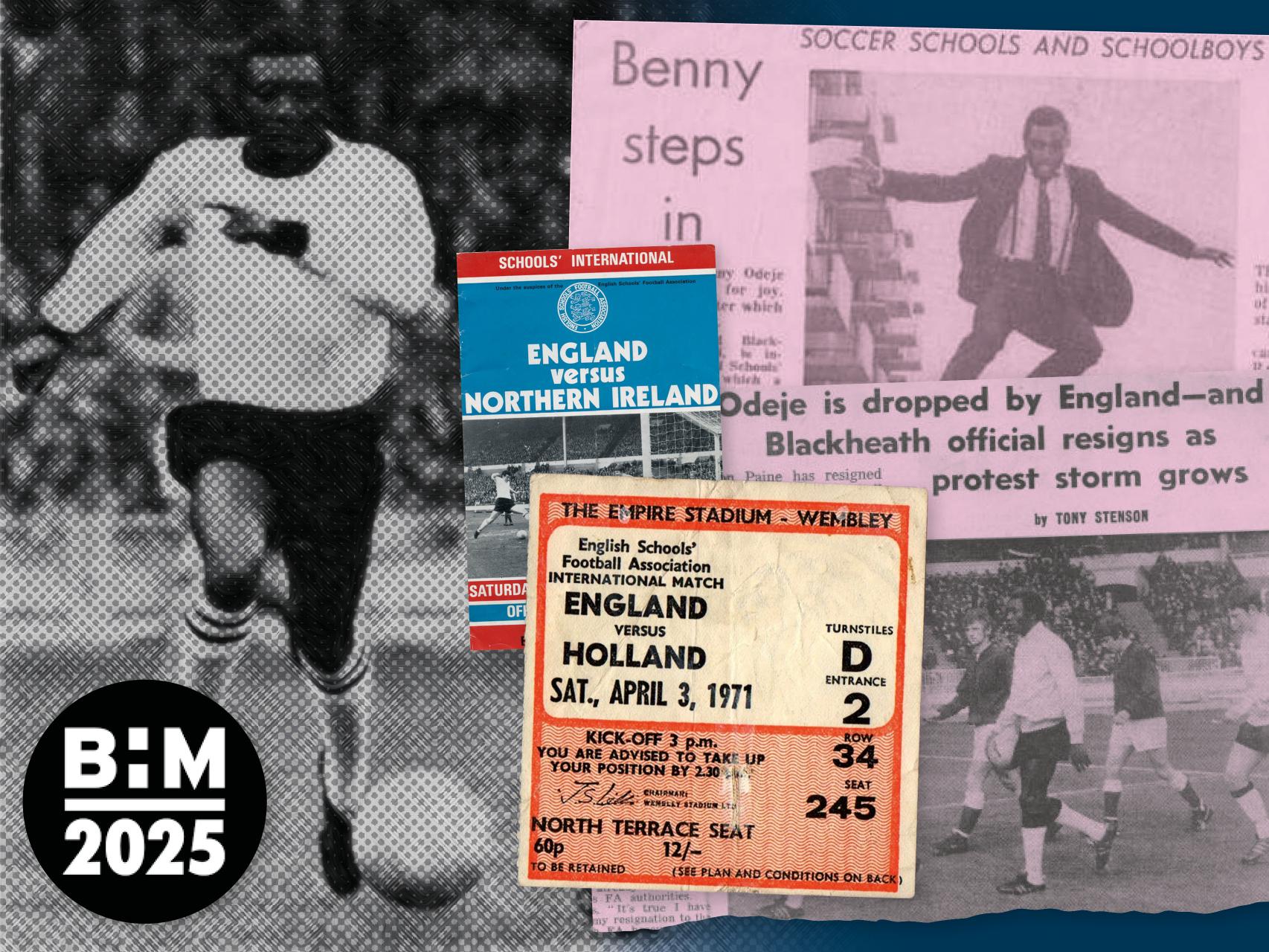
Odeje’s goalscoring feats had also attracted the interest of England scouts and his display in the final trial match at Northampton – he scored twice for The South playing against The North – resulted in the arrival of a letter confirming the Blackheath forwards selection for the England Schoolboys side to face Northern Ireland on March 6th 1971. Ben was almost certain to win an England cap, but not everyone was ecstatic. His father had concerns that the publicity surrounding 'the first African to play soccer for England', might make him 'a marked man', whilst his mother, a nurse, was far from happy. “She refused to come to Wembley,” Ben stated years later. “She reckoned football was a waste of time and I should be getting a proper education!”
England had a new team manager in Jim Morrow, but an early start to the schoolboy season resulted in an attendance of just 24,000 – Wembley's lowest for a schoolboy international. With Brian Bason becoming the first England player to make ten schoolboy appearances, a 15-year-old Odeje was picked, but played out of position on the right-wing. "I remember standing in the Wembley tunnel waiting to come on, the band was still playing..." Odeje told the BBC in 2013, "...and my knees were shaking. If someone had
said, 'Would you like to stop?' I would've said 'Yes' – because I was so nervous." England won 1-0 thanks to Roy Morton's 58th minute goal. Odeje's own performance drew good reviews, with some reports naming him Man of the Match.
But controversy followed ahead of the two sides meeting again, in Portadown, just a fortnight later. Ben was mysteriously dropped, prompting Catford schoolmaster Don Paine to resign from the Blackheath FA after 25 years in protest over Odeje's shock omission. Cliff Marshall followed Odeje as England's second black player, but it was Northern Ireland who kicked off the Victory Shield with their first win against England since 1947 – although the growing civil unrest in the province, meant that an English side would not visit again for a schoolboy international until 1989.
Seven days later at Ninian Park in Cardiff, Odeje was back in an England team that produced their biggest victory (5-0) in Wales since 1914. Ben then kept his place for the match against the Netherlands on Saturday 3rd April. This time, in front of 55,000, he played in his natural centre-forward position and scored in a 5-1 win over a Dutch side that included future Spurs and Fulham boss Martin Jol. Three weeks on, 60,000 were in Berlin’s Olympiastadion as England drew 2-2 and on the 27th April, just three days later, Ben's fifth schoolboy appearance ended in a 1-0 defeat against the West Germans in Karlsruhe.
But it would also prove to be his last. Back in England, Odeje – along with future Bolton and Everton star Peter Reid – was an unused substitute as England beat Scotland 3-1 at Maine Road, Manchester on May 15th 1971. The Scots needed just a draw for a fourth successive Victory Shield success, but a dominant England picked up the silverware outright for the first time since 1967. And that was that. With the next Schoolboy match not scheduled until
March 1972, the fixtures for Odeje's age group were over. The following year’s cohort would include Ray Wilkins.
Odeje spent the summer of 1971 in France playing with Charlton's youth team and he later set up the goal that earned a 1972/73 FA Youth Cup quarter-finals spot, but he never made a first team appearance for the Addicks. Instead he gravitated to non-league football playing for Hendon, Finchley, Clapton and, in both 1974/75 and again in 1976/77, Dulwich Hamlet. In time, he moved to Plymouth to complete a University degree in Recreation and Community Studies – playing for Wiltshire's Trowbridge Town to fund his studies during those three years.
Odeje has stated that playing for his country was the proudest achievement of his life whilst adding, “It's up there with finally making my mum happy. The happiest day of her life was when I graduated with a degree.” He became a PE teacher and for many years coached at QPR, before setting up his own soccer school in north London. But history seemed to have forgotten him. Until a 2013 BBC investigation identified his 1971 England appearances, prompting the FA to update the record books and in 2022 confirm Ben Odeje as "the first black player to represent England at any level".
Address
Champion Hill Stadium,
Edgar Kail Way,
East Dulwich,
London.
SE22 8BD.
