


TEAM TALK: Anthony Cook

TIME TO SIT DOWN WITH THE CHARISMATIC 'COOKIE'...
NAME Anthony Cook
SHIRT NO. 2/23
POSITION Everywhere...
Team you support and your childhood footballing hero?
Arsenal and Ian Wright.
When did you first come to Champion Hill?
2018/19 – the clubs first season at Step 2 in the National League South.
How did you come to re-join Hamlet?
A very long story to answer in a just a few words…
But I’m glad to be home.
Where do you play and what's your best position?
Attacking midfield. I’ve scored and created goals throughout my career. Extremely versatile, I’m equally comfortable at full-back or wing-back.
Played for anyone else?
Cardiff City, Dagenham & Redbridge, Concord Rangers, Chelmsford City, Ebbsfleet United, Bromley, Welling United, Cray Wanderers. Last season I was at Rayners Lane.
Any trophies in the cabinet?
I’ve my fair share of Player of the Season and Players Player of the Season awards. I was a National League South winner with Bromley in 2014/15 and a National League South Playoff Final winner with
Ebbsfleet two seasons later. I also won the Kent Senior Cup with Ebbsfleet in 2013 and got a Middlesex Senior Cup winners medal last season at Rayners Lane with Mark Dacey.
Best football moment so far?
Certainly winning those promotions with Ebbsfleet and Bromley. But also, returning home to Champion Hill with Dulwich on Boxing Day in 2018 and beating Eastbourne Borough 2-1. What a day that was!
Who would you consider the best player you've ever played alongside and why?
A difficult question as I’ve played with many good players, but I’ll say Daryl McMahon, who is now the Hornchurch manager - he was in centre-mid when I was at Ebbsfleet and we had a great understanding on the pitch. Honourable mention to Aaron Ramsey at Cardiff City.
Best goal you've scored?
I have a tendency to score very good goals. Let’s say the most recent one against Canvey Island on my second Dulwich debut – that one, a looping half volley from thirty yards to clinch all three points wasn’t half bad!
Toughest Opponent?
Jason Puncheon - first touch and footballing brain caused me all sorts of problems - he went on to play at the highest level. No surprise.
Favourite moment since returning to the club?
The trip to Altona! It was great bonding with both the players and fans! Thank you all for making that happen.
Hopes for this season?
Building a culture and playing in a team that everyone can be proud of. In other words, making Dulwich, Dulwich Hamlet again.
Favourite stadium you’ve played in?
I played against Arsenal at The Emirates for Cardiff in the FA Youth Cup.
Favourite other sport?
Boxing.
If you could change one rule?
The new ‘Five Sub’ rule. An absolute time killer, especially in non-league. Let players play!
Tuesday night at Champion Hill:
We return to Champion Hill on Tuesday night as Harrow Borough visit SE22. It's the return of our football for a fiver initiative and you can get your tickets here.
This article originally appeared in the Dulwich Hamlet Match Day Programme
You can download PDFs of previous issues here.
THE LESSER-KNOWN TALE OF A DULWICH HAMLET PIONEER.
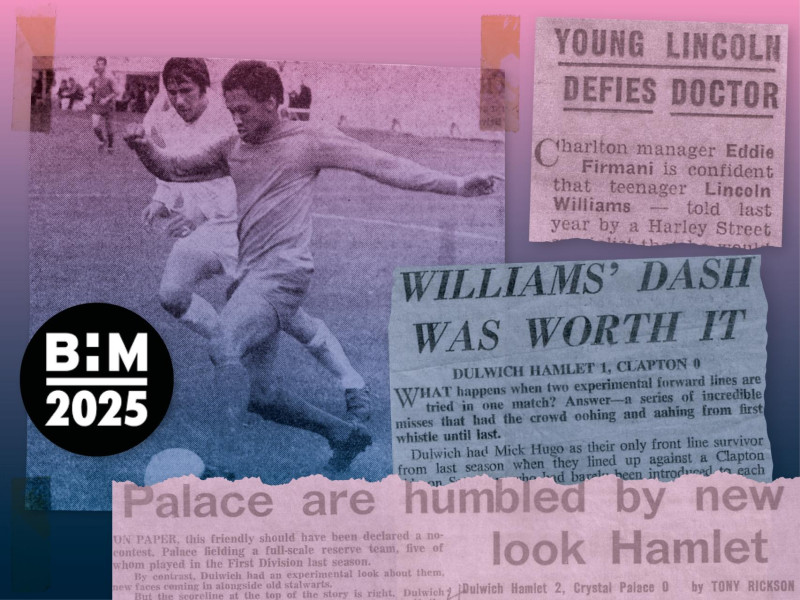
Dulwich Hamlet Football Club remains a very special memory for me..." says 73-year-old Lincoln Williams as he reflects on his time at Champion Hill fifty-five years later. A name unfamiliar to most Hamlet fans, Williams is believed to be the first Black British player to have represented the Club.
A promising youngster, he joined QPR straight from school, but often limped badly after playing. After tests, a Harley Street specialist concluded that the teenager would 'cripple himself' if he pursued a career playing top class football. That medical verdict preceding his release by the west London club.
But rivals Charlton Athletic, who had already shown interest in the talented young forward, sought a second medical opinion. This time the advice offered a more positive conclusion. Williams was admitted to hospital and underwent a successful operation to insert metal pins into both his knees and was told by specialists afterwards: "You can play soccer again." Then Addicks manager Eddie Firmani agreed, saying at the time: "Lincoln is the best prospect I've seen for a long time...and he is still only seventy-five per cent fit!" Firmani was confident that the teenager would be pressing for a First Team spot at The Valley with the Division Two club the following season.
But that potential Football League career wasn't to be and aged 18, the former Charlton colt, found himself instead being offered an opportunity over in East Dulwich by Hamlet boss Peter Gleeson. "I had experienced professional football, but by the summer of 1970, I was eighteen years old and at Dulwich," states Williams. "But I really enjoyed the experience of playing again, in the way that I'd first enjoyed playing as a young schoolboy. The thing I remember most about playing for Hamlet at that time, was the camaraderie – the training was fun. If I remember correctly, I was the only black player, but I didn't experience any unwelcome or racist treatment from either players or fans. A lot of the other Dulwich players also had experience of professional clubs, enduring their own setbacks and disappointments... not quite progressing as they'd hoped. But what we all had in common was a desire to play good football."
After being with the Reserves, Williams got his First Team opportunity on a Monday night in early August with the preseason visit of a Crystal Palace XI. The visitor's starting lineup was effectively their reserve side. By full-time they'd utilised 16 players including five with First Division experience – amongst them £15,000 summer signing Gerry Humphreys. "Palace put out a strong team, in what for them was just a warm-up match before the real season started," recalls Williams.
By contrast Dulwich had an experimental look about them... some new faces, including Lincoln, coming in alongside old stalwarts. "We beat them two-nil and I scored both goals..." beams Williams now. "I actually scored another goal whilst it was one-nil, but it was disallowed – John Smith, who had previously played for Palace as a Junior, adjudged to have been offside." In fact, Williams had netted the first goal after just thirty seconds, racing in to score with his first touch in First Team football, when 17-year old Palace 'keeper Chris Large could only half stop a powerful shot – John Smith having burst onto Vic Heasman's through ball that had carved the visitors defence wide open.
Despite making those five second-half substitutions Palace couldn't breach a Hamlet rearguard well-marshalled by Peter Smith and John Crotty, the two defenders backed up by a commanding display from goalkeeper Brian Wakefield. Whilst the referee missed a handling offence by Smith (Peter) in the penalty area, he also ruled out that 68th minute Williams header. But just three minutes later Lincoln, who according to one report, "showed a great knack for being in the right place, at the right time", was on the spot again – sticking a foot out to re-direct Heasman's cross-shot into the net and double the Hamlet lead. It was a surprising but deserved friendly win, with the local press gushing about the prospects for Dulwich's new look side: 'The skill and professionalism of Palace wasn't enough to contain the enthusiasm and sparkle of Dulwich who must be looking forward to a good season.' Lincoln concurs: "That game we showed to ourselves that we could compete with the big boys," he says all these years later. "We all believed we could be in that Palace side ourselves!"
The Dulwich Hamlet lineup that night was:
Brian Wakefield; Billy Wallace, John Harding, Peter Smith, John Crotty, Tony Slade (c),
John Smith, Dave Hollingdale, Billy Boon
(Mike Hugo), Vic Heasman, Lincoln Williams
Having scored with his first touch against Palace, Williams, by now bristling with confidence, almost repeated the feat when he made his Isthmian League debut at Champion Hill against Clapton on Saturday 15th August. In a new look Hamlet attack described as 'experimental', Williams lined up as a winger alongside established forward Mike Hugo and fellow newcomer Dave Hollingdale – a Southern Amateur League protegee. Lincoln only arrived at the famous old ground minutes before kick-off, following a hectic dash from work. This time it took him just five minutes to make his mark on the game – his first touch, a header, that left the Clapton bar shuddering. Despite missing a host of chances, Hamlet got off to a winning start thanks to Heasman's late goal. One match report concluded that both Williams and Hollingdale had... 'good games and promised enough to suggest they'll become firm favourites at Champion Hill.'
But once again, it wasn't to be. After half a dozen appearances and one Senior goal – he scored in a 2-1 early November defeat at home against Hampton in the Premier Midweek Floodlight League – Lincoln's time with Dulwich Hamlet came to an end. Until recently.
Having lived and worked in Jamaica for many years, he recently returned to the UK and reached out to his old club. "Now I'm back living in the area again, I wanted to reconnect. I'd like to thank Liam Hickey for the positive response I received. That was encouraging and reflected well on the kind of club Hamlet is today, as well as the one I remember so fondly from back then in the early seventies," he confides.
"It was a great bunch of guys. We trained twice a week and played on Saturday's. But in order to be free to play at all, I needed a different job to the one I had with Dales Menswear in Streatham Hill. One of the directors, or perhaps even the owner, ran a cleaning company called OCS and got me a job that enabled me to train in the week and also play on Saturday's. The income paid my rent and also enabled me to recommence my education, passing the exams I needed to access higher education. Looking back now, this period was a critical juncture in my life."
"All these years later, I like the idea of having a local team I feel connected to. And I'm very happy to be able to share this experience with my son Robert, who also lives locally. He's an Arsenal supporter, but I'll forgive him for that! I'd really like to thank the club for recognising me as a former player. I'm looking forward to watching and supporting the team."
So there you have it. Lincoln Williams. A true Hamlet pioneer.
With thanks to Richard Watts and the Dulwich Hamlet FC History GroupThis article originally appeared in Dulwich Hamlet's Match Day Programme on Sat 11th October 2025.
You can download previous issues here.
SEPTEMBER 18th WAS THE 81st ANNIVERSARY OF THE YOUNGEST AND LAST HAMLET CASUALTY OF WORLD WAR II
September marks the 81st anniversary of Operation Market Garden, still a controversial episode of the Second World War, immortalised in the book and film 'A Bridge Too Far' which perpetuates several myths but at least keeps the event alive for the public at large.
Less well known, even amongst Hamlet fans is that this battle saw the death of our youngest and final casualty of that global conflict.
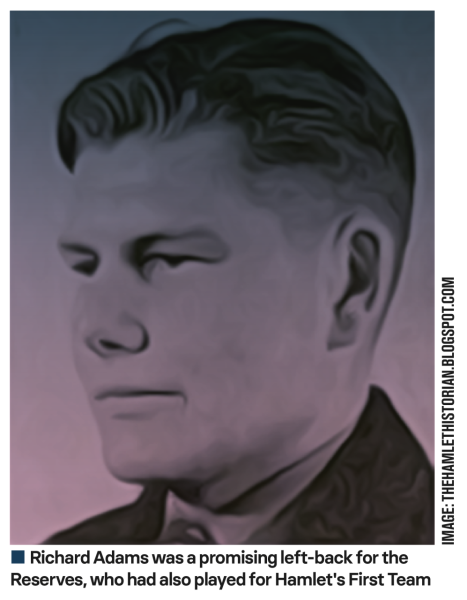
Richard Allen (Alan) Adams was born in Camberwell on May 22nd 1925. At the time of his death, he was living at 58 Sunray Avenue in Herne Hill with the rest of his family. He had been a pupil of Archbishop Tenison’s Grammar School in Kennington and on the outbreak of war, had been evacuated out of the capital to the relative safety of Reading in Berkshire. He was an accomplished sportsman and represented his school at athletics, cricket and football – both of the latter two at First XI level.
Alan left school in mid-1941, returning to live at the family home and taking a job as a Junior Insurance Clerk. Alan also joined his local Home Guard Unit. Based at Lordship Lane he was there from 1942 pending his enlistment into the Army proper.
It was whilst serving with the Home Guard that the then 17-year old made his senior debut for the Hamlet on Saturday November 7th 1942. He played at Champion Hill in a 4-4 draw against the London Fire Force. Alan didn’t feature on the original team sheet but the following week’s programme explained that he had been a late call-up due to regular left-back Roger Bishop being detained at work and thus being unable to get to the ground in time for kick-off.
That day, a youthful Hamlet team had found themselves 2-1 down at half time but made a spirited fightback in the second half to salvage the draw. The report on the game went on to say that the performance was…
“reminiscent of the peace time days when it was a bye-word that Dulwich Hamlet always played their hardest when up against it.” This same programme, which was for a match against the RAF seven days later on Saturday November 14th 1942, went on to say that “….the youngsters mentioned will be heard of again.” – so we can only assume that Alan performed well on his senior debut.
Alan enlisted into the Army on May 6th 1943. After completing his basic training, he transferred to the Army Air Corps on January 14th 1944 having volunteered to train as a Pilot with the Glider Pilot Regiment. At this point, Alan was promoted to the rank of Corporal, with a further promotion to Sergeant following on June 15th 1944. He qualified as a glider pilot on July 27th 1944 and was then posted to E Squadron, No. 2 Wing. At the tender age of just 19, he was one of the youngest glider pilots in the British Army.
The role of a Glider Pilot was an extremely hazardous one. Not only were they expected to fly the heavily laden gliders into landing zones through hostile skies, but upon touching down, they were then expected to fight as infantrymen alongside the airborne troops they had just transported, required to survive until such time as they could be evacuated out of the landing zone back to friendly territory.
On September 18th 1944, the Horsa glider piloted by Adams left from RAF Down Ampney as part of the Second Wave of landings for Market Garden. Towed by a Dakota transport aircraft, the glider carried a heavy load of a Jeep plus two trailers full of ammunition as well as two passengers from Headquarters, 1 Airlanding Light Regiment, Royal Artillery.
The flight initially went according to plan but when approaching the landing zone at Wolfheze, the gliders came under fire from German flak. A shell burst close to the starboard wing of Alan’s aircraft, spraying him with shrapnel. Alan slumped over the controls and although his Second Pilot Richard Ennis took over, he could not recover full control, with the result that the glider overshot the Landing Zone and ploughed into trees at over 100mph. Ennis was catapulted through the Perspex windscreen whilst still strapped into his seat. Amazingly, along with two passengers in the rear, he survived unscathed, Sadly, Alan was crushed by the load behind him which shifted forward with the impact of the crash.
Alan’s death was reported in Hamlet's match programme for the fixture against Pinner on December 2nd 1944. It described him as “a promising left back for the Reserves, who had one or two games for the senior side before joining the Forces.” The same article also hints at a wider family connection with the club as it mentions that “his father used to referee some of our games on the top pitch.” Alan's remains are today interred at Oosterbeek War Cemetery, 7km west of Arnhem in the Netherlands.
With thanks to Steve Hunnisett and the Dulwich Hamlet FC History Group
DULWICH HAMLET & THE WAR TIME RED CROSS MATCHES
During World War Two the FA authorised FA Red Cross matches featuring representative teams with profits from the games going to the Red Cross charity organisation. Dulwich Hamlet were the first Amateur club to be awarded a Red Cross match. But poor weather meant the game – an FA XI against an RAF XI originally scheduled for February 3rd 1940 – was postponed. The match was re-arranged for March 30th and featured England captain Eddie Hapgood, Sam Bartram and Peter Doherty alongside figures less well-known today such as Amateur international Lester Finch and Full international Alf Kirchen.
A fortnight earlier a Red Cross match had been held at Guildford City with a crowd of 3,000 seeing the FA draw 1-1 with Surrey FA. Three Dulwich Hamlet men appeared in the match - Bill Parr on the FA team and both Reg Anderson and Henry Ball on Surrey’s side. Anderson and Parr would both be subsequently killed whilst serving with the RAF. Profits from the re-arranged Champion Hill match were split between the Red Cross and the St John War Organisation. Dulwich remained the first Amateur club to host such a fixture and appealed to their fans to turn up, describing it as ‘a red-letter day’ in Hamlet’s history. 12,000 spectators attended. Also present to report on the clash was the legendary Charles Buchan, who stated the match was very good value for the sixpence entrance fee. The RAF XI won 3-2 and Buchan felt that the FA XI’s Amateurs, including Hamlet players Horace Robbins and Anderson, were exposed in defence due to their lack of knowledge of the three back system. He suggested that they had 1937 FA Cup winner and wartime international goalkeeper Johnny Mapson to thank for keeping the defeat to a respectable score.
Roger Deason
TEAMS: FA XI – Mapson (Sunderland), Robbins (Dulwich), Hapgood (Arsenal), Lewis (W'stow Ave), Oakes (Charlton), Weaver (Chelsea), Duns (Charlton), Anderson (Dulwich), Morrison (Spurs), Goulden
(West Ham), Bott (LPTB – a short notice reserve)
RAF XI – Bartram (Charlton), Griffiths
(Man Utd), Scott (Arsenal), Crayston (Arsenal), Brown (Huddersfield), Buckingham (Spurs),
King (Wolves), Ainsley (Leeds), Kirchen (Arsenal), Doherty (Man City), Finch (Barnet)
Once in the 1920s and again in the 1980s, Hamlet SIDES HAVE ENCOUNTERED FORMER WORLD CHAMPIONS...
Have you heard the one about the ‘World Cup winner’ who played against Dulwich Hamlet?
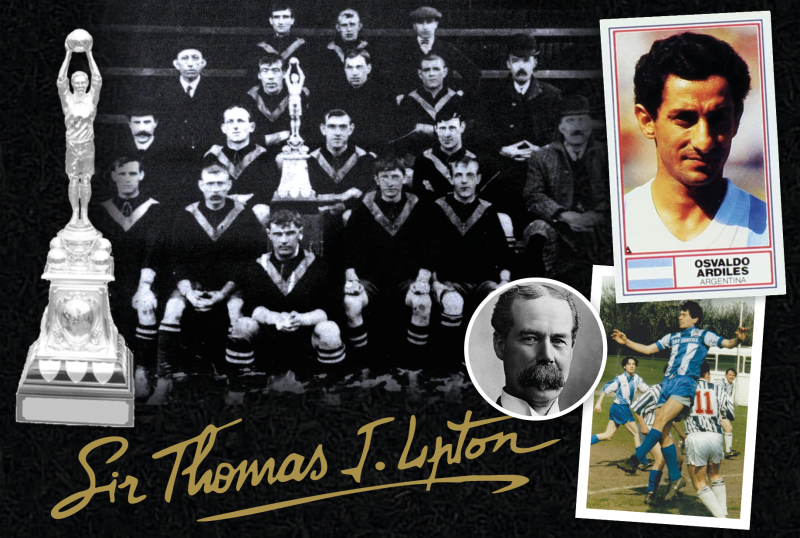
Well, sort of. County Durham amateurs West Auckland FC famously won the Sir Thomas Lipton Trophy in 1909 and then again in 1911. The competition, an invitational tournament held twice in Turin, featured elite club sides from Italy, Germany and Switzerland. With the development of football elsewhere not considered to be as advanced as the game being played in Europe at the time, these tournaments are considered by some to be the original World Cup’s – which is perhaps pushing it a little, but still.
In 1909, with the English FA declining an invitation to send a side, one of the tournament’s patrons, the British entrepreneur, tea magnate and sport enthusiast Sir Thomas Lipton, sent for the coal miners of West Auckland FC. Their team duly went on to lift the trophy after two triumphs in two days - both by a 2-0 scoreline. First they beat German side Stuttgarter Sportfreunde in the semi-final, before winning against Zurich based Swiss outfit FC Winterthur in the final on Saturday April 12th 1909. West Auckland then returned to Italy two years later to successfully defend their title. This time they beat a then amateur Juventus FC side 6-1 in the final on April 17th 1911 – and were awarded the trophy outright.
One player who featured in both victories was Tom Tucker Wilson – although you often won’t find that name in any of the records. The reason being that his father, William Gill Wilson, was known to all as ‘Billy Gill’ and it was widely assumed that his son Tom was also a Gill. So Tom usually answered to the name ‘Tucker Gill’.
He went on to play until he was 40, picking up FA Amateur Cup winners medals with Bishop Auckland in both 1921 and 1922. The first of those years also saw him crowned as a handball champion – sources differ as to whether this title was for becoming British champion or World champion. Handball a version of fives, that’s now largely confined to high end schools, was once very popular in the North East of England. Large crowds watched and large amounts of money was gambled. Handball has also been described as the Welsh national sport prior to the arrival of Methodism.
Hamlet met ‘The Two Blues’ of Auckland in the Amateur Cup in both 1920 and 1922. In 1920 Bishop Auckland returned north after being thrashed 5-1 by a Hamlet side that then went on to win the trophy. However, no team line-up has thus far been discovered to confirm the Bishop Auckland side that day.
Dulwich and The Bishops then met again in a 1922 semi-final. Before a 0-0 draw at Craven Cottage, the band had played ‘The Teddy Bears Picnic’, but in the replay at Darlington, it was the North East side who triumphed 3-0. In a hard fought contest, Bishop Auckland finished the match with just nine players having lost Stephen Freak to an injury just before half-time and then having Tommy Maddison sent off with fifteen minutes to go. Whilst no team line-ups have been found, reports state that Bishop Auckland were ‘full strength’, aside from one named change, making it highly likely that ‘Tucker Gill’ appeared against Hamlet in that match.
Whilst Tucker didn’t win a FIFA World Cup winners medal, it is quite possible that one man who does possess such a treasure played against Dulwich Hamlet on October 27th 1984. Without a fixture that day, Hamlet hastily arranged a friendly against a Spurs XI at the north London club’s Cheshunt training ground. Whilst Tottenham’s First XI – including goalkeeper Ray Clemence – were busy winning 4-1 against Stoke City, a second string Spurs lineup got a run out against Hamlet.
Whilst the game was announced in the north London press, Dulwich considered it a ‘behind closed doors' friendly and thus only certain people were alerted to its existence. But amongst those who did watch that day, are some who will state categorically that Argentina's 1978 World Cup winner Osvaldo Ardiles came on for the Tottenham side. Hamlet won 4-1 and Ardiles never appeared in the Spurs team subsequently listed in North London media reports. However, Ossie was coming back from a long-term injury at the time, so it’s quite possible that Tottenham boss Peter Shreeves quietly sanctioned his inclusion as an agreed extra substitute, far away from the media gaze and the eyeballs of the general public as well as potentially adoring Spurs fans unable to make it to White Hart Lane.
The Tottenham team that was listed for the friendly was: Parkes; Danny Thomas, Toms, D. Martin, Ian Culverhouse, Ian Crook, Richard Cooke, Allan Cockram, David Leworthy, Danny Maddix and substitute M. Ryan. Four of the Spurs XI were just 16 years of age and whilst some went on to have good professional careers, others, such as Allan Cockram and David Leworthy, would instead become big names in non-league football.
What no-one could have anticipated, was that the most successful subsequent career trajectory of anyone there that day arguably belongs to a Hamlet supporting child. After signing for Dulwich Reserves from the DHFC Supporters Team, Stephen Child (pictured above) then ceased playing altogether in order to pursue officiating. Rising through the ranks, he gained recognition as one of the world’s leading Assistant Referees, ultimately making the FIFA list before hanging up his flag in 2019.
With thanks to Roger Deason and the Dulwich Hamlet FC History Group
TEAM TALK: Michael Chambers
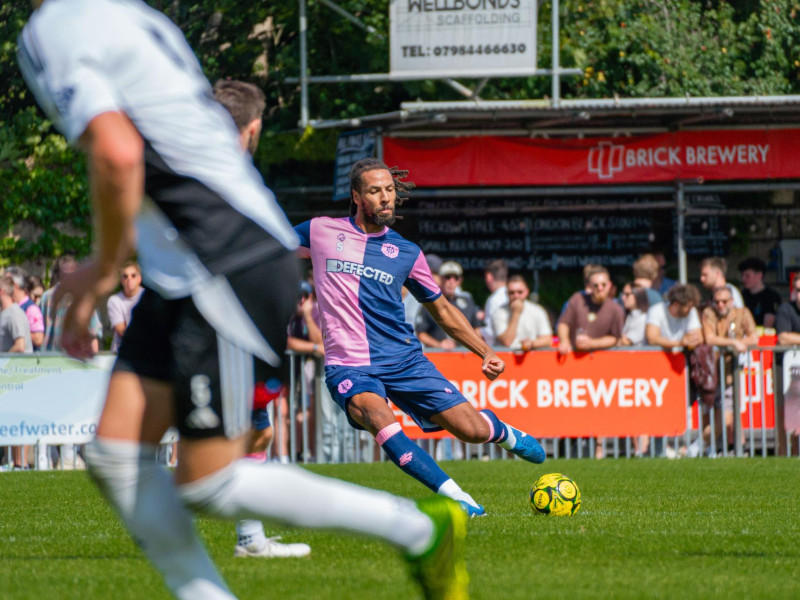
NAME MICHAEL CHAMBERS
SHIRT NO. 5
POSITION CENTRE BACK
Which team do you you support apart from Dulwich Hamlet?
West Ham
Who is your childhood footballing hero?
Rio Ferdinand
When did you first come to Champion Hill?
When I was 16 years old.
How did you come to join Dulwich Hamlet?
Long story, but started in Aspire Academy and then progressed into the first team, then left a few times and came back.
Where do you play on the pitch?
Centre back.
Can you play anywhere else?
Lol. I like to think I can but probably not.
What other clubs have you played for previously?
Millwall, Crystal Palace & Billericay are the clubs I’ve spent the longest time at
Any trophies in the cabinet?
Yep (want to add more)
Who would you consider the best player you've ever played alongside?
Paul Pogba
Best moment in football?
Went to watch Iniesta last game at the Camp
Nou.
Tell us about the best goal you've scored?
Best goal I’ve scored in a little while was my 63rd minute goal against Hashtag in our 3-3 away draw last season.
What is your favourite moment since joining Dulwich?
Winning promotion, hopefully not the last promotion!
Hopes and ambitions for
the new season ahead?
Win games and have fun doing it.
Favourite sports apart from football?
Basketball or Formula 1
If you could change one rule in football, what would it be?
I would like them to leave the rules alone for a minute.

Address
Champion Hill Stadium,
Edgar Kail Way,
East Dulwich,
London.
SE22 8BD.
Information
Social Media
